Saturday, May 19, 2012

The Blood and the Land

A FACT FINDING REPORT on AMOUSI CARNAGE in KHAGARIA DISTRICT
Jaya Mehta, Vineet Tiwari and Sunita Kumari

The first reaction of anyone who is from Bihar or who knows Bihar well, was like, “No. Mushars can’t do it.” The issue was holding 14 Mushars responsible for Amousi carnage by sessions court of Khagaria. The court ordered death sentence to ten and life imprisonment to four Mushars from Amousi village. Seeing the news in newspaper, we were puzzled that the judgment came so fast and 10 Mushars were sentenced to death. We talked to various people in Patna and Khagaria over the telephone. We were told by CPI comrades that those accused and convicted in the case were innocent and seven of them were members of CPI. The case required further investigation. We then decided to go there ourselves and see the land and the people.

Judgment on Amousi Massacre

In a judgment delivered by sessions court of Khagaria, ten people were sentenced to death and four were given life imprisonment. They were held responsible by the court for the massacre which took place in Amousi village of Khagaria district in Bihar. Sixteen people were killed in the night of 1 October 2009 at around 11 pm in Amousi. All of them were from Kurmi community except for two who were Kushwaha. Eight of them were young boys in their teens.
On the basis of FIR lodged at Morkahi police station, the police arrested 30 or more people from Amousi village. A trial took place in sessions court of Khagaria on the 28 persons accused in the case. Twenty six of them belonged to Mushar community and the remaining two were Dhanuks. The judgment was delivered on 14 Feb 2012, in which 14 persons have been acquitted and 14 have been given punishment. An appeal has been filed in Patna high court.
Two more persons accused in the case are awaiting trial in Khagaria jail.

Investigating Team and the Scope of Enquiry

Jaya Mehta, Vineet Tiwari and Sunita Kumari went to Khagaria town and from there to Amousi village on 1st and 2nd April 2012. The purpose of the visit was to make a preliminary enquiry to ascertain if there existed sufficiently many factual details to indicate that those accused were indeed innocent and had been falsely implicated in the case.

  1. We talked to the local party comrades of CPI and a reporter of ‘Hindustan’ who is stationed in Khagaria and who covered the case.
  2. We interrogated the two under-trials in Khagaria Jail.
  3. We talked to the relatives of those convicted in the case and other residents of Amousi village.
  4. We read carefully the judgment delivered by sessions court, the PUCL enquiry report (enquiry conducted on 11th October 2009), the relevant news coverage and some papers related to land conflict in Amousi.
We were assisted in our investigation by Comrade Puneet Mukhia, (Anchal Mantri of Alouli Block, CPI), Advocate Chandra Kishore Yadav (assistant to Adv Durgesh Pandit Singh – one of the defense lawyer in the sessions court), Comrade PP Singh (Khagaria District Secretary, CPI), Manoj Sada (Branch Secretary, Amousi, CPI), Bharosi Sada and some other villagers. Veteran public figures Comrade Satyanarayan Singh (Ex MLA, CPI) and Comrade P. S. Singh (Ex District Secretary of Khagaria, CPI) facilitated our trip. They also provided an overview of case and the background details.

A Background of Khagaria District

Khagaria district was carved out of Munger district in 1981. The entire district is criss-crossed by number of rivers and a large part of it constitutes an extremely difficult terrain. The region gets flooded during monsoons. Further, the topography of the region changes frequently because the rivers change their course. As a result cultivable land gets submerged in water at one place and land emerges afresh at another.


Historians have recorded that when Raja Todarmal, the revenue expert under Akbar reached this area for measurement of land, he could not measure the land because of river streams and thick Khagaria grass that grew in the area. He abandoned the exercise separating the area from others and named this area as Farakiya land i.e. separate or different land. The area remained un-surveyed during the British period also. As a result, a number of Zamindars belonging to other districts took possession of land in this region. No accounting has been possible of this illegally possessed land. When Zamindari was abolished and ceiling was imposed, many of them did not disclose their land situated in this district.
The non-resident Zamindars protected their unaccounted land and obtained income from it by employing local musclemen (popularly known as Bahubalis). This continues even today. The local population is mostly landless, cultivating land either as landless labour or as bataidar. Some were allotted land, which was given under Bhoodan or which was released under land ceiling act, but the allotment remained mostly on paper.
People do not obtain physical possession of land. Some others have taken possession of small holdings, which they have been cultivating for long but they do not have the legal papers for it. Even today, the land records available with district revenue administration present a great deal of disorder and a number of anomalies. Bandhyopadhyay commission reports that when the commission asked for proper records, they were told that original records must be with Munger district. On further probing they were told that most of the records have got drowned in the flood of 1987.


As the revenue administration, till date, is being run without proper land records, It is not surprising that there are a large number of land disputes spread over the area. There has been a recurrence of militant Maoist struggles also in certain parts of the district. Most of the grievances arise out of inability of people to take physical possession of land that has been allotted to them on paper. Bandhyopadhyay commission also heard many complaints from Bataidars. Bataidars, even when cultivating their land for a long time, get arbitrarily thrown out by the non-resident Zamindars and their Bahubalis.
The state government or local administration have taken no action till date to get rid of this unjust and illegal control of land by erstwhile Zamindars.

Land Conflict in Amousi

Amousi village is a hundred year old village situated in Alouli Block in Khagaria district. Alouli Block has a higher proportion of scheduled caste population compared to the rest of Khagaraia District. According to the 2011 census, the proportion of scheduled caste population in Khagaria is 10 percent, while in Alouli Block it is more than 25 percent. Most of these SCs are Mushars. Mushars are mainly landless agricultural labourers living in remote areas. Especially in Bihar, 95.3 per cent Mushar workers are agricultural labourers. Only 2.5 per cent are cultivators and 2.1 per cent are in other services.[1]
Amousi village (mouza) is comprised of around 100 Mushar households. Some may be Dhanuk (lower rung of OBC) households also. There is only a cluster of huts in this village. People live in extreme poverty. There is no pucca construction, no road and no market in the village. It is situated in diara[2]  land and is not easily accessible. One has to cross three streams of Kamla (Bagmati) river in boat and a sea of cement like Baluwai (fine and sandy) soil to reach the place.
The Kurmis who were killed in Amousi Bahiyar[3] on 1st October 2009 were not the residents of Amousi village. They belonged to village Icharwa, which is situated on the other side of three streams of Kamla river. The distance between the two villages is three kilometres or more. Icharwa is a relatively big village with a population of 5000. Situated by the roadside the village is dominated by Kurmis (the upper OBCs).
In the 1960s, the Government of Bihar took up river embankment programme in a big way. A dam was constructed over river Bagmati and the river changed its course. This led to the emergence of a big chunk of cultivable land (around 400 acres) in Amousi Bahiyar. The Zamindars of Samastipur, Munger and Begusarai claimed their right over this land. According to Bihar Government, the land was Gair Mazarua[4] government land. There is a reference to a court case — Lakhmeshwar Prasad vs. state of Bihar for 170 Beegha of land, which was settled in favour of the State of Bihar by Patna high court in 1998. There is also a reference to land owner Ram Bahadur Sigh and his contractor Kamla Sahay for 366 Beegha of land in Amousi Baharia. It is noted that Ram Bahadur Singh or Kamla Sahay never personally cultivated the land, neither did they file any returns for it. Eventually, the land in question was merged with government land.


This kind of boat is used to cross the streams with jeep

The legal dispute over ownership of land in Amousi Bahiyar has apparently been settled in favour of the Government of Bihar.
The de-facto control over this land was, however, with the Kurmis of Icharwa village. The details of how they took possession of this land are not clear but such a practice is not un-common in diara land. There are many villages in diara, where land is owned (or possessed) by families residing across the river. It is said that some Kurmi families made the agreements with the Zamindars when the case was sub-judice. They paid some amount to the Zamindar to get the permission to cultivate a particular piece of land. The term of the negotiation was that if the Zamindar won the case; he would sell the land fulfilling the legal requirements (It is called Kewala). It is also possible that some of the families just occupied the land because it was not guarded by any one. In either case, it is not likely that the Kurmis in Icharwa village cultivating the land in Amousi Bahiyar have proper legal titles for the land that they possess. There are big land holders among Icharwa Kurmis like Vashishth Narayan Singh possessing 30 Beegha of land. He is the JDU president for Alouli block. There are also small farmers possessing 1 or 2 Beegha of land. Many of the Kurmis are also cultivating land as share croppers.


As the river changed its course, the fertile land emerged

On the other hand the Mushars in Amousi and other neighbouring villages worked as agricultural labourers in the fields. After the land was legally settled as government land in 1998, Mushars made claims that the land be settled in their favour-1 acre per family. As many as 81 families had papers showing that the land was allotted to them under Bhoodan. Bharosi Sada (CPI member) and 80 others made application for settlement of Bhoodan land. The SDM issued orders for the settlement but the Circle Officer waylaid the case.


Residences of the convicted in Amousi

Some others did not wait for the administration to settle the case and started cultivating the land holdings, which they thought should be legally transferred to them. This was resented by the Kurmis. There are reports of small skirmishes between Mushars in Amousi and the Kurmis in Icharwa. There is a complaint filed by O.P. Mahto (CPI member) and others in 2005 that they were being threatened by the goons. They were asked to surrender their land, otherwise the consequences would be serious.
This conflict over land between Mushars and Kurmis provided the motive for killings. In addition the region has presence of militant Maoist groups, who would facilitate the carnage. The immediate reaction from every quarter was that Mushars were organised by Maoist to indulge in this brutal killings. However, things are more complex than this apparently straightforward story knitted so simply.
The Maoist denied having any hand in it. The government and police also did not repeat the involvement of Maoists. One fails to understand if no organised support base was available how did the poor Mushars obtain the guns for shooting and how could they muster the courage to indulge in such a heinous crime collectively? One hears of rivalry between two groups of Kurmis in Icharwa village. The basis of the division was political rivalry. One group associated itself with the existing MLA and younger brother of Ramvilas Paswan, Paras Paswan. Another group was with the Nitish Kumar. The two groups of Kurmis had some clashes between them because of the local elections. The Paswan group was unhappy with Nitish’s appeasement of Mahadalits. If it could be established that Mushars were responsible for brutal killings of Kurmis, it would embarrass Nitish. It would also give credence to the charge that Nitish was unable control Naxal violence in the area. At the same time if Mushars were implicated in gruesome killings, their legal battle for land claims would be quashed forever and illegal hold over land by the Kurmis would continue unchallenged. Those who were leading the legal battle for getting land settlement have been selectively convicted in the case. This insidious political plot cannot be ruled out in the semi feudal milieu of the remote areas of Khagariya.

Incident on 1st October 2009

Sixteen people were killed in the night of 1 October 2009 at around 11 pm in Amousi Bahiar. All these people were residents of Icharwa village. The farm land and basa (shelter for a person to guard his land and cattle) of these Icharwa villagers was in Amousi bahiar which is more than a kilometer away from the residential area. At the time of the tragedy the Icharwa villagers were sleeping at their basas.
The incident is reconstructed on the basis of account narrated by Paro Singh who claimed to be the eyewitness (!). There are two versions available to us. One, given in the PUCL report based on enquiry conducted on 11th October 2009 and the other recorded as evidence in the judgment delivered by session court on 14th Feb 2012.

PUCL Report

PUCL team visited Icharwa and Amousi villages on 11 October 2009. In Icharwa, they met, several members of the families of the deceased who had congregated by the wayside for Dashkarma i.e. getting their heads shaved. They also met Paro Singh there. According to PUCL team, Paro Singh was the only person who claimed to be an eyewitness of the incident. As narrated by the villagers and Paro Singh. The chronology of event is given below:

Some people forced a boatman of Icharwa to ferry them to Amousi Bahiar late in the evening. The boatman was later killed and no details could be traced. Presumably, after crossing the river, another group of armed persons joined them. From the river bank they followed nearly a straight line to reach the basas of Icharwa Kurmis. The miscreants picked up young men sleeping in their basas. All the picked up persons were allegedly tied up with ropes and they were huddled together in an open area on the dera of Chhotelal Singh. Here, they were shot by guns. Paro Singh said that he feigned death lying motionless with other corpses making the killers think that he was dead. The team did not find his version of hoodwinking the killers very convincing. There was no injury on his body. The killers dispersed after shooting. Paro singh managed to flee from there and reached village Icharwa to tell others about the carnage. The villagers informed the local Alauli police station. Icharwa village comes under the jurisdiction of Alauli police station. The police was reluctant to go to Amousi at that late hour of night. The villagers mustered courage and crossed the river in large number and brought back the dead bodies by five in the morning.

Among the persons killed while 14 were Kurmis, two were kushwahas. In the morning police inspector from Morkahi Police station arrived and Paro Singh lodged an FIR with him. (Amousi Bahiar falls under the jurisdiction of Morkahi Police Station). As many as 37 persons are accused in the FIR with names. Besides, 20 to 25 unidentified persons are also mentioned as part of the group of killers. The list is headed by Bodhan Sada and O.P. Mahto.

Evidence Recorded in the Judgment

The judgment records the eye witness account of five persons as evidence. All the witnesses are interested parties as their sons have been killed in the incident.
Paro Singh’s evidence in the court does not mention people arriving in the boat from other side of the river. There is no mention of any boatman. The evidence as recorded in the judgment only says that at 11’0’ clock he was at his basa with his son Chandan Singh. His son was sleeping while he was awake. He saw 40 to 50 people armed with rifles and guns coming from south west side. They were flashing torch. He describes how these armed people caught hold of 10 to12 people from their respective separate basas. After that 10 to 15 people came to his basa. Paro Singh tried to wake up his son but his son Chandan Singh did not wake up. Paro Singh hid himself in a nearby paddy field. The miscreants picked up his son and took every one to Chotelal Singh’s dera. They tied the hands of all the victims.
Paro Singh states that Bodhan Sada asked the victims why they had not vacated their deras when they had been ordered to do so. Paro Singh’s son replied that he would vacate his dera next day. But Bodhan Sada ordered that they all be shot dead and the group shot the victims with their guns. Paro Singh states that the miscreants wanted to make sure that the victims were actually dead and they flashed light on the victims. In this light Paro Singh identified 16 miscreants with names. After making sure that the victims were dead they fled towards north. Paro Singh also reports hearing two rounds of firing at Chhotelal Mahto’s dera.
Paro Singh stated that he then came to bank of the river where he met Chotelal Singh, Jaichand Singh, Anrudh Singh and Kamli Singh. These are four other eyewitnesses who narrated similar stories and identified the miscreants by names. Like Paro singh they are affected parties having lost their sons in the carnage
All five of them went to Icharwa village and narrated the incident to other villagers. Around 100 to 150 people crossed the river at night and went to Chhotelal Singh’s dera. They brought the dead bodies back to Icharwa chouk. In the morning Mukesh Kumar S.H.O. Morkahi came. Paro Singh lodged his FIR at 7.45 a.m. on 2 October 2009.
We also got the version of local party comrades, the family members of the accused and other villagers in Amousi. We were told the there was no eyewitness of the incident and no one knew who the miscreants were. They could only say that those charged with the crime were innocent. All those convicted in the case had alibi for the night of 1 October 2009. According to them no Mushar from Amousi village was involved in the crime.

The Judgment of the Sessions Court

The judgment delivered by the sessions court seems to rely entirely on the eye witness account given by Paro Singh and others. We do not have the entire case file and we are not trained to probe into such matters but there are points on which we feel clarification is required.
  1. Evidence of Paro Singh as recorded in the judgment raises at least three questions.

When he describes the miscreants picking up 12 persons from their separate deras, one needs to know if all the deras were visible from the place where he was stationed. And did it not give him enough time to wake up his son?
He refers to miscreants flashing torch light at the victims and says that he recognised the culprits in that light. But actually reverse is the case. If someone flashes torchlight in your direction, his or her own image becomes less distinct.
Paro Singh reports the conversation that took place between his son and Bodhan Sada at Chotelal Singh’s dera. But Paro Sigh was hiding at his own dera .Was this conversation loud enough for him to hear from the paddy field, where he was hiding.

2.      The judgment refers to postmortem reports, empty cartridges, blood stained clothes and other items put as exhibits. However, no mention is made of the guns and rifles which were used on that day? One would like to know what search was made for the guns and rifles.

3.      There is some discrepancy regarding Police inspector’s presence at Icharwa chowck on 2nd morning. There is also some use of whitener. This raises doubts about the genuineness of FIR lodged by Paro Singh on 2nd morning.

Appeal in High Court

An appeal is filed in High Court against the sessions court judgment. The lawyer Ajay Thakur has been retained as the defence lawyer by Mushar Seva Sangh. We consulted some friends in Delhi and we were advised that for a case dealing with 14 accused one lawyer is not sufficient. You need more than one lawyer in the case. When we met the wives of those pronounced guilty in the case they were ignorant of the appeal that is filed with High Court.
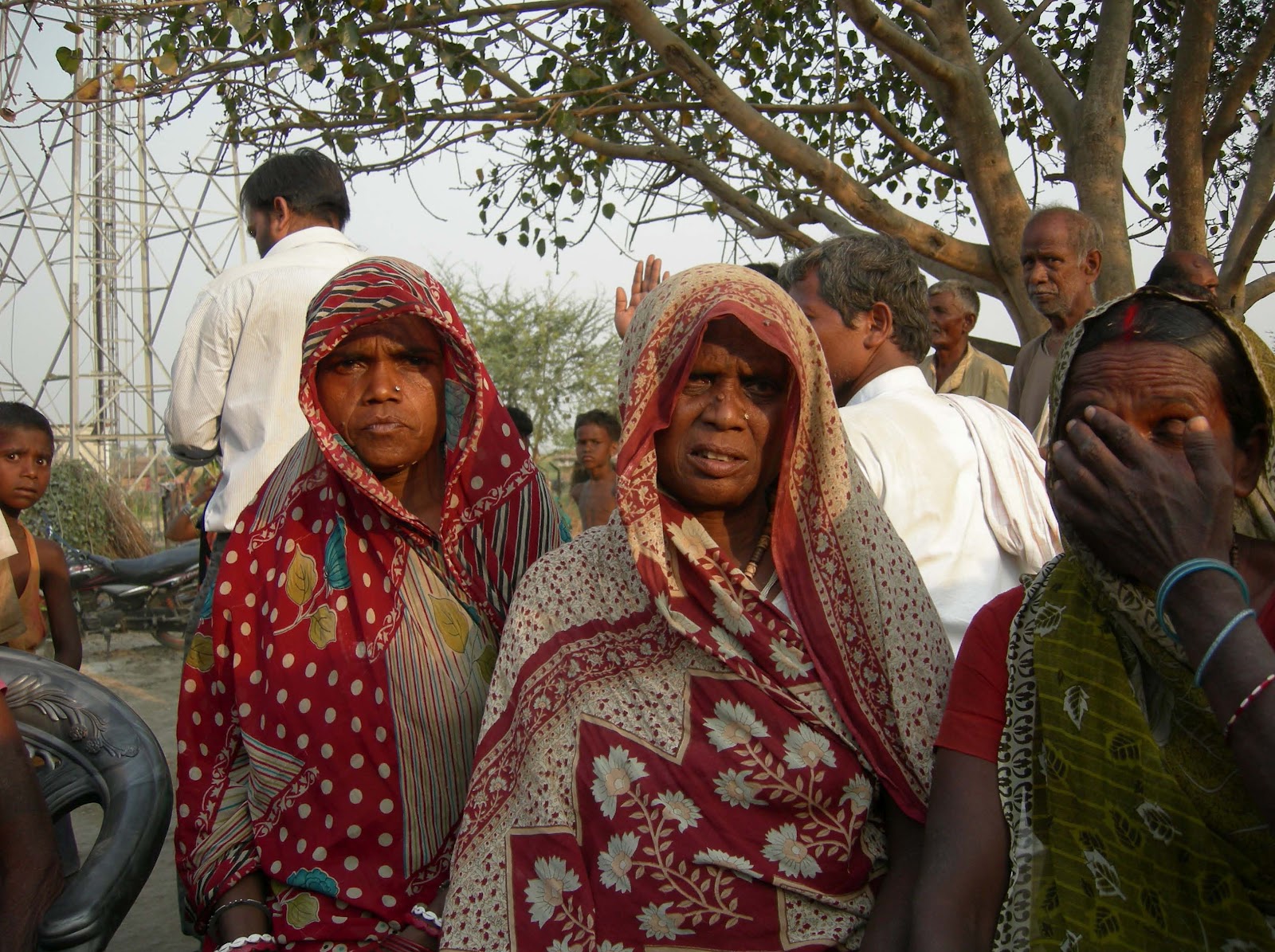
Women of Amousi village whose men are in jail

Lakhubai, whose husband Harinarayan Sada and son Sanatan Sada are in jail

A recent development

After we came back from Amousi and were preparing this report, we got the information from Khagaria that on the evening of 17 April, 2012, one more resident of Icharwa was killed at  Amousi Bahiyar. This time the person who was accused for the killing was no other than the Paro Singh himself. The incident was narrated by advocate Chandrakishore Yadav whose residence is also near Amousi and Manoj Sada who lives in Siripur village which is hardly one km away from Amousi village.
Pandav Kumar, who was killed on 17 was the son of Dhana singh of Icharwa village.Dhana Singh lost his other son in the Amousi carnage of 2009. He was one of the witnesses in the sessions court trial.
On 17 April 2012, Paro Singh, Phoolchand Yadav (a resident of a nearby village Kashimpur), Ramashish Singh and Pandav Kumar (both from Icharwa) were seen going to a neighborhood village Saharwa, 1 km of Amousi where liquor is sold. Phoolchand Yadav is not a resident of the village but he has a basa where he keeps his cattle at Amousi Bahiyar.
Manoj Sada and his companion Sadarath Sada (Amousi) found all four of them coming back from Saharwa on the way to Amousi. They were drunk and they tried to obstruct the way of Manoj Sada. Manoj dodged and avoided any skirmish with them. Later, according to Advocate Chandrakishore Yadav, other villagers of Amousi also saw them passing through the village in drunken state. He also said that Paro Singh misbehaved with a woman of Amousi for which a policeman scolded upon him. (A team of some policemen has been stationed permanently in Amousi since the 2009 carnage). Many villagers witnessed them passing through the Amousi village. The time was around 6 or 7 pm.
Later, some villagers of Icharwa found that Phoolchand Yadav was running away with his cattle and they asked him that what happened. He was nervous and told the villagers that somebody murdered Pandav Kumar. Meanwhile, Paro Singh reached Icharwa village and said that Pandav Kumar was killed by Amousi Mahadalits. Villagers did not believe him as some of them heard the version of Phoolchand Yadav also. The villagers had seen all four of them going together. When Paro Singh realized that villagers are not ready to trust him, he absconded. But villagers did not allow Phoolchand Yadav to abscond till the police came in midnight. Police also arrested Ramashish Singh from the village.
The body of Pandav Kumar was found. He was strangled by gamchha cloth. The father of the deceased Pandav Kumar, Dhana Singh, filed an FIR accusing 5 people. These included the above mentioned three and Chhotelal Singh and Pappu Singh.
According to local people, some dispute came up between Dhana Singh and Paro Singh regarding their stand on 2009 case. It is assumed that Dhana Singh was asking Rs. 50,000 to continue his stand in high court. Paro Singh got agitated with his demand and when son of Dhana Singh, Pandav Kumar was with him and he was drunk, Paro Singh thought it would be easy to kill him and once again implicate the Mushars of Amousi in the case. But Phoolchand Yadav could not digest this and the conspiracy of falsely implicating Mushars in the murder case failed.
Paro Singh’s involvement in such a serious crime has to be investigated. It certainly puts a big question mark on the evidence given by him in the trial of 2009 carnage. His eye witness account is central to the judgment pronounced by the sessions court.

Post Scripts

Post Script 1: Judgment on Bathani Tola Massacre: Two judgments, Two parameters

In the recent judgment of Patna high court on Bathani Tola massacre, all the accused were acquitted. On 11 July 1996, Ranvir Sena killed 21 people in Bathani Tola in Bhojpur district of Bihar. 12 women and 8 children were murdered. The abdomen of a pregnant woman was slit open. A little infant’s tongue was cut off. Another baby’s fingers were severed from her hand. A girl in the prime of her youth was raped and before she was put to death, her breasts were chopped off. The victims belonged to poor muslim families, who had been displaced from Kharaon village.The conflict was regarding access to village common land for buriel and namaz. Ranvir Sena had forcibly occupied the Kabristan and Karbala land of Muslims in surrounding villages.When the muslim families protested, they were taught a lesson.
On 16 May 2010, the sessions court in Ara convicted 23 accused. Three were given death sentence and 20 were given life imprisonment. Patna high court on 16 July 2012 acquitted all the 23 convicts. According to the high court, the prosecution failed to prove the involvement of the accused in the crime beyond reasonable doubt.

Post Script 2: Those awaiting trial

We met two under trials in Khagaria jail, Gorelal Sada and Devendra Chowdhry.Their profiles once again point out that anyone, who defies the unjust land order in rural Bihar will be punished.

Gorelal Sada
Gorelal Sada (age 55 years) is a member of district Counsel of CPI Khagaria. He has a house and family in Shravita village in Ananthpur Panchayat. He has been cultivating 3 bighas of land as a sharecropper for last 30 years. The land belongs to a zamindar Kesar Babu from Sanhouli. For last 5 years he has stopped paying any rent for the land that he cultivates. The zamindar is angry because of his land is illegally taken possession of. According to Gorelal Sada, he has falsely been implicated in 2 other criminal cases because of the conflict over these 3 bighas of land. In Chikkani Tola village of Saharsa, where one cop was killed in an encounter in May 2009 between Maoists and SAP (Special Auxiliary Police). Gorelal Sada spent one year in jail and was released on 25 September 2009. The Amousi massacre took place on 1-2 October 2009 and once again he saw his name in the list of accused. When he found out that there was an arrest warrant in his name, he absconded and remained in hiding for 2 and ½ years. He was finally caught by the Police on 25 March 2012 from his house. His trial will begin on 19th April 2012 in Khagaria court.
Gorelal Sada has six sons and four daughters. Although he himself can barely sign his name but his sons are educated till class X. One of them has a grocery shop and others migrate to Punjab in search of employment. When we asked him if his family has visited him in the jail, he said, “No. They will get time to see me only after harvesting of rabi crop (Maize) is over.”
On the night of 1 October 2009, Gorelal sada was sleeping in the Party Office of Khagaria district. He was there because he was campaigning for Advocate Chandrakishore Yadav in PACS elections. He said that he did not know anybody in Icharwa village, and knew some people in Amousi village.

Devendra Chowdhry s/o Surendra Choudhry, Age 40 years
Devendra Choudhry lives in a village called Jheema in Amousi Anantpur Panchayat. He has five sons and 2 daughters. He belongs to Kewat or Mallah community. Amousi, the place of occurrence is about 1 kilometre away from his village Jheema but there is a stream in between.
His case is rather more surprising. He said that his father has land title for 5 bighas of land which he also cultivates along with four other brothers. He explained that there is 120 bighas of land in the village which has long been cultivated by villagers. The land is distributed like this that 40 bighas of land is given to Sada community people for cultivation and 80 bighas of land has been cultivated by Choudhry, i.e. Kewat-Malhar community. This arrangement was done by villagers themselves depending upon the population distribution. The land was under possession of Rai Bahadur of Munger in pre independence period. Devendra Choudhry said that some Neeraj Singh, who is a Bahubali of the area, claimed that he purchased 40 bighas of land. That became the conflict between Neeraj Singh and villagers. Devendra Choudhry said that he was falsely implicated in some case of extortion, kidnapping and attempt to murder, etc. The case was registered in Khairi village and it has been there for five years so he was absconding for many years. After that the October incident happened in Amousi and he saw his name in the Amousi carnage too as an accused, so he surrendered to Police on 16 November 2009. He was arrested in both the cases. His trial has yet not begun.
He said that he was in his house only on and around that time when carnage took place.

Post Script 3: The main accused among the convicts

The list of accused is headed by Bodhan Sada and O.P. Mahto. Death sentence is pronounced for Bodhan Sada and O. P. Mahto has been given life imprisonment.

Bodhan Sada
Bodhan Sada, aged 60 years, was earlier the area commander of a maoist group of the region. As reported by local people, when Bodhan was asked by Party to shift to Saharsa, he rebelled and was consequently expelled from the party. A new area commander was given charge. Yogi Mahto and Bodhan Sada naturally had tussles between them. Bodhan Sada is said to have considerable influence among Mushars of the area. His wife was the Mukhia (chief) of the village when the massacre took place. Since then, his wife has been killed and Yogi Mahto has been accused in her murder’s case. While in Jail, Bodhan Sada was put up by CPI (ML) as a candidate for 2010 assembly elections.

O.P. Mahto
At the time of massacre, O. P. Mahto (age 72 years) was the branch secretary of CPI. He was one of the prominent leaders in the Amousi Mushars’ legal battles to claim the Bhoodan land in the region. We were given a copy of the written complaint made by O. P. Mahto to the Distict Collector. In his complaint he has said that he was threatened for life by some Bahubalis of the area. They warned him that if he doesn’t give up his legal battle, he will face dire consequences.
*****
Contact: jaya_mehta@hotmail.com, comvineet@gmail.com, janamfoundation@gmail.com

Jaya Mehta is a senior Economist. She is associated with the Joshi-Adhikari Institute of Social Studies.
Vineet Tiwari is a writer and activist. He is associated with Joshi-Adhikari Institute of Social Studies.
Sunita Kumari is an activist associated with JANAMFoundation.


[1] No_Border.pdf, Daanish Books.
[2] The land which emerges as the river changes its course.
[3] The farm land around the village is called Bahiyar in local dialect.
[4] Land, usually not under cultivation for long stretch of time. It could be private (khas) or common (aam).

Friday, May 4, 2012

Present International and National Situation and Our Tasks


Provisional Central Committee
Communist Party of India (Marxist-Leninist)
The PCC met during 4-6 February, 2012.

The following conclusions were arrived at after prolonged discussions at the meeting of PCC.
  • Deficit reduction has become the mantra for big finance and the super monopolies since they were bailed out after 2008 by huge state funds, causing the huge deficits in the first place. This has resulted in drastic and inhuman cuts in welfare and large-scale and rising unemployment. Health, education, food availability, pensions and other welfare measures have been badly affected. In plain terms it means that the burden of the crisis caused immediately by deregulated finance has been pushed on to the shoulders of the working and middle classes. This story repeats itself all over the US, Japan and Europe, the core area of world capitalism. Nowhere in this area will finance capital allow the reinstatement of regulations that were in place before the triumphal march of finance capital. The sharp decline in the rate of profit in manufacturing forces capitalism to financialise and more  unbridled speculation will hasten it to its doom sooner than later.
  • Core capitalist countries and their multinational monopolies still control world production by producing very high-tech items and designs in their own countries. The rest of production is contracted out  to peripheral countries according to the availability of cheap unskilled, semi-skilled and skilled labour. Eastern Europe and the leading ASEAN countries have the skilled and semi-skilled labour to produce the intermediate products that are then sent mainly to China to become finished products through largely cheap and unskilled labour.
  • Although the lion’s share of the profits from such a process goes into the coffers of the multinationals, the monopolies have also to share a part of the profits with powerful peripheral (national-comprador) monopolies. This has given rise to strong middle income countries such as China, India, Brazil, South Africa, etc. These countries have more or less small home markets and depend on cheap labour to export raw materials, services, and manufactured goods. The shrinkage of markets due to the crisis has affected these countries in accordance with how much they have opened up to foreign capital and its commands. The Chinese and the Indian state still retain some restrictions on foreign capital and have saved themselves to a certain extent from the full impact of the crisis. But their GDP growth and, especially, their growth in manufactures have slowed down. 
  • In India, the ruling classes appear divided over what is termed “the next generation of reforms”. The dream team of the Bretton Woods twins (i.e. US imperialism) headed by Manmohan Singh and its cohorts consisting of Pawar and others are trying to press full steam ahead towards deregulating the entry and exit conditions of imperialist capital, changing the labour laws for such entry, curtailing the social wage and privatisation. On the other hand, there are forces that would appear against such moves or at least to be more cautious about them. This division is also reflected to some extent in foreign policy initiatives such as on Iran, China, Pakistan, Afghanistan, the Doha round, etc.
  • The world economic crisis and the shifting of its burden onto the working people throughout the world have provoked widespread resistance struggles. In countries such as the US, Spain, Greece, Italy and France, these struggles have achieved a qualitatively new dimension by bringing forward capitalism as the enemy, a position that is unprecedented for the last half century or so. The OWS in the US is in the forefront of this development, but the Greek and Spanish movements are not very far behind. The working classes in these countries are yet to fully mobilise behind this development, but the struggles in Wisconsin, Oakland and New York promise greater things to come. But as of now, the anti-capitalist struggles are the arena for ideological struggle on what is to be done and how. The failures of the actually existing socialisms of the last century are still roadblocks on the way to clear understandings. Without a thorough overhaul of our ideas on socialism, the working class movement cannot move forward towards world-wide victory.
  • In India, the contradictory tendencies within the ruling classes have not proceeded to the extent of any splits or even the full identification of specific forces in contention. But it is clear that in the political arena, these tendencies and the rise and consolidation of various kinds of regional forces have weakened the ruling class parties, mainly the two big ones, considerably. This has created grave instability and opened up spaces for the workers and the poor and lower middle classes to consolidate the innumerable ongoing struggles against, in essence, capitalism and imperialism.
  • With its limited strength, the party and other unofficial left parties and formations, must abjure the kind of left adventurism practiced by the CPI (Maoist) and lead mass struggles on class and identity issues while uniting as and when possible with all forces, including regional forces and parties, NGOs and others. Imperialism must be the focus of our struggles and all forces which oppose particular imperialist policies without being against all such policies in any thoroughgoing manner should also be united with on issue to issue considerations. Only such a policy can unleash the mass struggle on a national scale.
  • All forces to the left of the official left parties must build up close unity leading to possible mergers. But such mergers are still quite rare and unstable. While our unions and unions in which we work have begun to federate with the NTUI, we have discovered that this federation is a heterogeneous body combining industrial workers, rural and informal workers. Large non-party left forces are active in it, although some undesirable NGO-type elements are also there. Mutual learning among these powerful working class forces and struggling steadfastly against alien elements could deliver both a strong working class movement and a firm left unity.  


Two documents on International Communist Movement


The devastations of imperialist globalisation, wars of aggression and the devastating economic crisis of the imperialist system and its impact on proletarians and the broad masses have awakened worldwide a wave of struggles and revolts.

In this context a potential new wave of the world proletarian revolution develops and emerges, with the people's wars led by Maoist parties as its reference points and strategic anchor. The realisation of this potential ultimately depends on how successful the Marxist-Leninist-Maoist parties are in fulfilling their revolutionary tasks at national and international level. The pooling of their understanding and experience and the development of their capacity to take a united revolutionary message to the rebellious masses all over the world, have decisive importance. Unfortunately there has been a lag in this matter. This is severely compounded by the crisis in the Revolutionary Internationalist Movement (RIM), which is now defunct.

In this situation steps need to be taken to work for the building of an effective international MLM organization that can aid the fulfilment of revolutionary tasks and take the collective voice of the Maoists to the proletariat and struggling peoples. Therefore, we should move towards holding a new conference of the Marxist-Leninist-Maoist parties and organizations throughout the world. This conference should take up the task of building an international organization based on Marxism-Leninism-Maoism.

It is appropriate that this task should be informed by the positive and negative experiences of RIM, given its experience in building and functioning as an international organisation during its nearly three decades of existence. As part of the work for the conference and the building of an international organization we need a summation worked out by all the parties and organization which has been part of this experience. Here we put forward some preliminary views.

1.      Following Mao Zedong’s death in 1976, the Chinese revisionists seized political power through a military coup d’état, thus causing the Communist Party of China (CPC) to degenerate into a revisionist party––overthrowing proletarian political power, bringing down socialism, and transforming revolutionary China into reactionary China. Moreover, the emergence of the Hoxhaite revisionist line in the Party of Labour of Albania, influenced a certain number of communist parties and organizations throughout the world, and ended up producing a serious assault on the international communist movement.

Despite this context of defeat, some Marxist-Leninist parties and organizations, that did not follow either the Chinese or Hoxhaite variants of revisionism, though few in number, held the first international conference of Marxist-Leninist parties and organizations in 1980 and passed a Joint Communiqué, A Call to the Proletariat and the Oppressed Peoples of the World. Although this conference did not result in the creation of a stable international organization it prepared the ground for a second international conference in 1984.

The formation of the Revolutionary Internationalist Movement (RIM) in this second conference of 1984 was a positive international, theoretical and practical endeavour that responded to the ideological, political and organizational needs and necessities of the international communist movement in the circumstances of a period defined by the crisis that had engulfed the communist movement following the defeat of the Chinese revolution.

The Declaration of the Revolutionary Internationalist Movement that was passed at this conference - on the basis of Marxism-Leninism- Maoism (Mao Zedong Thought as it was then termed) and a principled opposition to the modern Russian and Chinese revisionism (as well as the Hoxhaite dogmato-revisionism) - provided a basic ideological-political framework for the foundation of the movement .

2.      In its past three decades of struggles the Revolutionary Internationalist Movement, since it was based on Marxism-Leninism-Maoism, achieved important theoretical and practical gains that were principled and worthy of further development. The documents passed in the international conferences and the expanded meetings of RIM (like the Declaration of the Revolutionary Internationalist Movement, Long Live Marxism-Leninism-Maoism, and the Millennium Resolution), despite some of their deficiencies and shortcomings, were all important theoretical contributions to the advancement of the Movement, as part of the international communist movement. The internationalist support to the people’s war in Peru and PCP, including the historical campaign in defence of Dr: Abimael Guzman, the contribution and support for the start and continuation of the people’s war in Nepal for its ten years, the publishing of the journal A World To Win in several languages that allowed to make known ideological and political understandings and analysis of the Movement and its parties and organizations in different countries, and statements issued have been notable features of the role played by the RIM in the international communist movement.

3.      The founding conference of the RIM had recognised the necessity of building a new communist international of a new type. To realize this, the Declaration of the RIM correctly identified the twin tasks of evolving ‘a general line and a correct and viable organisational form, conforming to the complex reality of the present-day world and the challenges it poses.’

4.      The interim committee – conceived as an embryonic political center - was formed with the task of working for the process of furthering the ideological, political and organisational unity of communists, including the preparation of a draft proposal for a general line for the communist movement. But this task was not fulfilled by the Corim and the RIM could not reach this goal.

5.      In the experience of RIM, the existence of such a center, formed for enabling a consistent and unified role for this Movement has given mixed results. There were some good results. There have also been serious lapses, hegemonic tendencies in functioning that negated the collectiveness that was the RIM, sorely undermined its unity, hindered the incorporation of more MLM parties and thus blocked the fulfilment of the tasks it had set for itself.

The new international organization should have an executive centre, whose internal life and methods correspond to the stage and methods shared by the political parties and forces that give life to this organization. It should function with the competency and commitment to work within the framework of the decisions and agreements of the international organization as decided in its conferences and other meetings. As in all other matters, here too, the consistent defence, application and development of MLM and the fulfilment of their own internationalist tasks and obligations by the individual parties are the ultimate guarantee.
In spite of its positive aspects, our Movement could not fulfil the tasks it had taken up and entered a crisis. When revisionism of Bob Avakian’s post-MLM 'new synthesis' variety became dominant in the Revolutionary Communist Party-USA and of the Prachanda-Bhattarai variety became dominant in the United Communist Party of Nepal (Maoist), not only did these parties deviate from the path of revolution and communism, but the destructive and disparaging effects of their counter-revolutionary lines negatively affected the parties and organizations within RIM, specifically the Committee of RIM (CoRIM), in an extensive and profound manner. These are the immediate ideological sources that have led to the current crisis and collapse of the RIM.

We propose the convening of an international conference in order reactivate and reorganize an international organization. We believe that this task must be jointly taken up with the involvement of the Maoist parties leading people’s wars, and all the Maoist forces, including those outside the RIM, so that the conference will benefit from their views and experiences. In order to achieve this aim a process of ideological, political debate must be carried out. As part of preparation for the conference and serving its aims, we will it necessary to organise a seminar on ‘Summation of Experiences of RIM, ICML, and other International Initiatives.’

Through this whole process the points of unity and differences can be identified and a relatively advanced platform can be arrived at, to become the basis of a new international unity concretised in a new international organisation. In the current circumstances, the execution of this revolutionary responsibility can demonstrate a practical expression of the internationalist communist slogan, “workers and oppressed peoples of the world unite.” It is this that will allow the MLM communist parties to establish and develop Marxism-Leninism-Maoism, realize a new unity of the international communist movement, place it at the van of worldwide people’s struggles and fully unleash and realize the potential new wave of world revolution.

With revolutionary greetings,

Signed and diffused from

Communist (Maoist) Party of Afghanistan;
 Communist Party of India (M-L) [Naxalbari];
 Maoist Communist Party - Italy;

May first 2012

Document 2:
-----------

The imperialist system is going through the most severe crisis since the 1930s. The current attempts to address and overcome the crisis only serve to deepen and extend it.

The structural crisis that emerged in the field of finance has gradually extended to the field of production, bringing about a deepening recession. The crisis proceeds under the law of uneven development within the pursuit of the maximum extortion of surplus value and the contention on the world market.

The crisis has its origin in the laws of running of the capitalist system itself. It is the expression of the limits of production for profit, and the contradiction between productive forces and relations of production, including the general and global nature of the production and private appropriation. In the world scene this means an ever growing gap between the wealth of a handful of imperialist countries and the poverty of three quarters of human beings in the countries oppressed by imperialism, between the wealth in the hands of the bourgeoisie and the relative and absolute impoverishment of proletarians and masses in the imperialist countries , between the overflowing richness of a parasitic and comprador bourgeoisie and the living conditions of misery and hunger of the proletariat and broad masses in the countries oppressed by imperialism.

It is clear that a system dominated by these laws, these dynamics, can only go into crisis, and overproduction and capital surplus become factors of crisis.

The phenomena of heightened and speculative “financialization” are the tip of the iceberg of the dynamics of the system, which become point of implosion and explosion.

The “financialization” of the economy – the main immediate cause of the crisis – tends to reject any control. So the efforts of capitalism and its ruling imperialist powers to get out of crisis through regulation and control of the financial markets and use of the opportunities offered by high growth rates, even if disarticulated, of some countries such as China, India and Brazil have so far not succeeded. Although these efforts should not be underestimated, they cannot ensure more than a temporary recovery, one which opens the door to new and even more distressing crises.

The world is still faced with two possibilities: the exit from capitalism or a painful temporary recovery from this crisis by strengthening, enhancing the mechanisms of capital and thus prolonging the misery of the masses.

The imperialist bourgeoisie all over the world take advantage of the crisis to restructure imperialism on a global scale and save the interests of their class for their profits.

This leads to unloading the vicious weight of the crisis on the workers and masses. In both the oppressed countries and imperialist countries, unemployment, job insecurity and the cost of living increase, exploitation is ratcheted up to modern forms of slavery, workers' rights are reduced, social achievements won through years of struggles are erased, factories are closed with massive layoffs, peasants are ruined and driven to suicide, cuts in social expenditures and privatization of education and healthcare grow, the logic of commodification and profit is extended even to primary goods, such as water, air, sun, etc..
These policies are carried out within the contention for domination on the imperialist world market and geopolitical strategic areas, but the unitary character of the policies to unload crisis on the proletarians and the masses is emphatically clear.

The policy of imperialism accentuates and makes more and more catastrophic the effects of the system in terms of ecological and natural disasters. Imperialism transforms factors of development in the field of science, culture and education, information technology, access to media, communication, extension of the freedom of young people and the processes of emancipation of women, into new and more refined chains. In the context of crisis this results in massive intellectual unemployment, social control and most extreme forms of barbarism, new neo medieval attacks on women's rights and the regimentation of youth.
The balance of power among the imperialists is in a flux. Though the US still remains the sole super power its capacities have been considerably weakened, by the resistance of is victims and the crisis. This gave some room for the EU grouping. However similar factors have negatively impacted on their position too. Russia had not been affected so much by the crisis. Through its axis with China and consolidating ties with erstwhile Soviet Union republics, it has gained some advantage and has stepped up contention. Overall collusion is still principal in inter-imperialist relations. But imperialism in crisis, develops within it contradictions that can become potential sources of a new world war. Imperialist powers, mainly the US, unleash and accentuate wars of aggression, invasion, and neo-colonialism in the different regions of the world where their interests are vital or threatened. In developing these wars, it continues with the arms race and gets equipped with more and more devastating military instruments, surpassing all limits enshrined in international conventions and human rights.

One or the other form of fascistic control has always been the norm in oppressed countries, even where a parliamentary system exists. In recent years, a tendency to modern fascism grows inside the imperialist countries also. This takes shape according to the characteristics of history, the reality and the culture of each country. It strives to establish once again the totalitarian, racist, securitarian and police-state forms of the rule of the bourgeoisie.

Imperialism is poverty, reaction and war. The crisis reveals that welfare, democracy and peace become more and more words that cover an opposite substance.

The devastating economic crisis of imperialism and its impact on proletarians and the broad masses have awakened worldwide a wave of struggles and revolts.

In the countries oppressed by imperialism, the protests, rebellions and liberation struggles have found in the revolts in Arab countries and in the Persian Gulf a new height and a new dawn. Young people, proletarians and the masses and, in some cases, organized sectors of workers, attacked and overthrew dictatorial regimes subservient to imperialism that seemed permanent. This has paved the way for new anti-imperialist, anti-Zionist, anti-feudal, new-democratic revolutions.

False anti-imperialist regimes, such as those of Libya, Syria, Iran, and openly pro-imperialist ones such as those in Saudi Arabia, Bahrain. Yemen, Morocco, Algeria, as well as the military regimes that have replaced the reactionary tyrants in Tunisia and Egypt, unleashed massacres and repression. Hiding under the flag of democracy imperialism intervened in these struggles and maneuvered to remove unreliable regimes and replace worn out servitors with new ones. It launched a war and occupied Libya. But the wave of "Arab springtimes" continue. Globally they have achieved an important position as a new front in the battle between imperialism and the peoples. They join those existing in Iraq, Afghanistan and Palestine. In these countries, the occupation and invasions of imperialists and Zionists have faced heavy resistance. This forced them to reshape their occupation plans and prevented them in a substantial manner from realizing their aims. Apart from the Arab and West Asian countries, people in Latin America, Africa and other regions of Asia have repeatedly taken to the streets to resist the attacks on their livelihoods. The persistent and growing labor strikes and peasant struggles in China is notable.

In this new wave of struggle and resistance we must support and strengthen the struggle for the liberation of peoples and for new democracy, towards socialism and communism, and oppose the pro-Western and Islamist currents which ride the tiger of people’s struggles in order to impose new chains and new subordination to the reactionary classes and their masters of all time, imperialism, mainly of the U.S. and Europe.

The wave of unrest, flaring up of rebellions and struggles involving hundreds of thousands of youth in the imperialist countries is a distinguishing feature of the present world. The exciting uprisings of the proletarian youth, which shakes the imperialist citadels, marks the entry of a new generation. Facing a life without a future, through their rebellions they shout "it is right to rebel" and declare that it is capitalism that has no future. Now fused, now in parallel, this development is coupled to a rise in labor struggles. General strikes have summoned to action the whole workers movement, especially in countries hit hardest by the crisis Greece, Spain, Italy...

The workers' struggles have had a new development in Eastern Europe, where to the bite of wild capitalism following the collapse of false socialist regimes, was added the quick transformation into systems even worse than before.

New waves of immigrants flock to the imperialist countries in hope of a better life. They flee from poverty and war devastations caused by these countries. To reach their destinations they have to put their lives at risk through untold suffering which often turn the seas into cemeteries. The imperialists respond with harsh anti-immigrant laws and racism. The emergence of modern fascism, of police states, the growing frequency of wars of aggression and anti-immigrant laws have been responded to by the masses through the development of anti-fascist and anti-racist movements, and broad movements against the war.
This is the context in which a potential new wave of the world proletarian revolution develops and emerges. It has as its reference points and strategic anchor the people's wars led by Maoist parties.
To this we must add the preparation of several new people's wars, particularly in Turkey and South Asia, with the potential for it in Latin America, and throughout the rest of the world, with the constitution of Marxist-Leninist-Maoist (MLM) communist parties. In this framework, the new MLM communist parties in the imperialist countries represent the potential for a quantum leap in revolutionary struggle and the unity of the two currents of the world proletarian revolution: the socialist revolution in the imperialist countries and the new democratic revolution, marching towards socialism, in the countries oppressed by imperialism.
All this shows that the principal contradiction in the world is that between imperialism and oppressed peoples, while both the contradictions between the proletariat and bourgeoisie and the inter-imperialist contradictions also sharpen. In the crisis it is increasingly clear that the revolution is the main trend.
In the current international situation the task of communists is to make revolution in the different countries, because the revolution is the only solution to the crisis, the only way out from imperialism and the only road to achieve the ultimate goal of the struggles of the proletarians and oppressed people.

This demands the strengthening and building of MLM communist parties in each country, as a new kind of communist party, as vanguard detachments of the proletariat and leading core of all the people, as a party fighting for the revolution.

In the countries oppressed by imperialism the perspective of people's war is advancing. In India, the people's war led by the Communist Party of India (Maoist) successfully withstands unprecedented attacks by the enemy and is able to expand and advance. The people's war in the Philippines led by the Communist Party of the Phillipines advances and establishes itself as an important part of the wave of world revolution. The people's war in Peru, initiated under the leadership of the Communist Party of Peru led by chairman Gonzalo remains an ideological and strategic beacon for the whole international communist movement. Though it faces setback due to the attacks of the enemy and from revisionists within the party, the struggle to overcome these hurdles persists. In Nepal ten years of people's war enriched the history and experience of the international communist movement and made significant advance towards the victory of the new democratic revolution. In recent years, however, a revisionist line that betrays the people’s war and the revolution emerged, headed by Prachanda and Bhattarai. The Maoists within the United Communist Party of Nepal (Maoist) [UCPN(M)] must save the revolution and resume its march by revolting against that line and standing firm against centrist vacillations, inside and outside the party. In Turkey, the revolutionary struggles led by the Maoists are advancing in the pursuit of the people's war strategy suited to the conditions of this country, placed as it is amidst two international theatres, the European imperialist countries and the regimes ruled by the reactionaries in West Asia. In other countries of South Asia and Latin America, the people's war is in preparation for new beginnings and progresses. It is a task of communists around the world to put into the practice the proletarian internationalism, popularize and support the people’s wars and revolutionary struggles.

In the imperialist countries, electoralism, parliamentarism and political and union reformism are increasingly in crisis and, through this, revisionism is bankrupt. The need of a revolutionary organization and a revolutionary strategy to overthrow the bourgeoisie and seize the power is increasingly advancing and strengthening in the workers and people's movements.. The idea that as long as the proletarians are not in power it is an illusion to think that their lot will improve is growing. The workers' struggles and the uprisings of proletarians and young people must coordinate and grow within a perspective of overthrowing the governments and states of the imperialist bourgeoisie, for the seizure of power by the proletariat.

In order to transform these needs into reality, these movements into revolution, we need to build MLM communist parties, in the fire of class struggle and in close link with the masses, for the proletarian revolution, with the MLM strategy of the revolutionary war culminating with the insurrection, adapted to each country according to the concrete conditions.

In all countries we need communist parties based on Marxism-Leninism-Maoism, able to lead the class struggle in all fields and aimed at seizing the political power. In each country the Maoist communists strive to answer this need for a scientific and determined leadership for the class struggle, by fighting all kinds of revisionist and reformist, or dogmatist and extremist deviations, in all their forms.

Our class can rely on the huge amount of experience through 140 years of struggles and revolutions, from the birth of the glorious Paris Commune through the peaks of the October Revolution, the Chinese revolution and the Great Proletarian Cultural Revolution. We must learn from both our victories and defeats, from our correctness as well as from our mistakes.

Always in their entire history, the communists have built, participated and counted on an international organization of the proletariat and the oppressed masses. Without the First, the Second and Third International, the communist movement would not have spread to every corner of the world, neither would it have achieved its great victories, and would not have learned the lessons from its temporary defeats.
The battle of Mao Tsetung was an international battle that paved the way to the revival of communist parties after the establishment of Kruschevite revisionism in the international communist movement.
After Mao's death and the end of the Great Proletarian Cultural Revolution, the formation of the Revolutionary Internationalist Movement (RIM) has allowed the Marxist-Leninist-Maoists in the world to begin to unite on an international scale, to resume the march towards a new Communist International.

Today, facing the crisis and the collapse of the RIM, we must rebuild the international organization of MLM parties and organizations on the basis of the positive and negative experiences of the RIM. The current situation presents the need to unite in this new organization all the MLM parties and organizations, inside and outside the RIM, for a political and organizational leap. This is necessary to put the communist movement at the height of the class struggle in the new century. Thus the needs of the proletariat and the oppressed masses, facing the impact of the crisis of imperialism, can be met.

The new international organization must unite in its ranks the genuine MLM parties and organizations that exist and operate in the class struggle, that transform the revolutionary theory into revolutionary practice, that are able to be an advanced and integrant part of the proletariat and the oppressed masses, getting rid of all the old and new waste, not only of revisionism but also of the petty bourgeois revolutionaries and the self-referring "virtualism".

To build this new international organization we must break with revisionism in all its aspects and particularly with those that have led to the current crisis and collapse of the RIM, namely the post-MLM 'new synthesis' of Bob Avakian in the Revolutionary Communist Party,US and the revisionist line established by Prachanda/Bhattarai in the UCPN(M).

The new international organization should have an executive centre, whose internal life must correspond to the stage and methods shared by the political parties and forces that give life to this organization, particularly taking lesson from the positive and negative experiences of the CoRim.

The international organization of MLM communists is and should be the core of a front, of an international anti-imperialist alliance of the proletarians and oppressed peoples.

It is this that will allow the MLM communist parties to establish and develop Marxism-Leninism-Maoism, realize a new unity of the international communist movement, place it at the van of worldwide people’s struggles and fully unleash and realize the potential new wave of world revolution.

Imperialism has no future! The future belongs to communism!

Signed and diffused from

Communist (Maoist) Party of Afghanistan;
Communist Party of India (M-L) [Naxalbari];
Maoist Communist Party - Italy;

May first 2012

Appeal for support from Kalinganagar


BISTHAPAN  BIRODHI  JANAMANCHA , SUKHINDA (KALINGANAGAR)
P.O. SUKHINDA Dt JAJPUR  ORISSA

FROM  RABINDRA JARIKA ,SECRETARY
VILLAGE  CHANDIA  PHONE NO- 09938655827

To all democratic parties, organizations and individuals supporting the struggle of the Adivasis and Dalits against forcible displacement.

Dear friends,
The people of India know about the struggle of the Adivasis in Kalinganagar  and the martyrdom of 14 Adivasis in the struggle against forcible land acquisition by the Tatas in 2006. While that struggle is continuing, fresh attacks have started on the villages of Chandia, Baligoth, Chama Kutli, Gobarghati, Garhpur, Belhari and Ambagaria in Kalinganagar. The Tatas want  to broaden the Expressway connecting Daitary Mines to Paradip Port. So they want to evict the Adivasis and acquire their land. The people are opposed to this and they have refused to vacate their villages. Now the Tatas have formed an armed group of nearly 500 men They are all armed with guns..At 11 AM on 30th March 2010, this armed gang assisted by Orissa State Police and some BJD (Biju Janata Dal) activists attacked the village Baligota. 22 villagers including six women got gunshot injuries. The marauder gang dishonoured the women, burnt the houses of the movement leaders and smashed three motorcycles and 25 bicycles. They looted all goats and hen from the village. Since the attack was sudden and the people unprepared, so they could not resist..

The movement against forcible land acquisitions by the Tatas is being led by Bisthapan Birodhi Janamancha, Sukhinda. Our movement is a peaceful and democratic movement. We only want that the right over Jal, Jangal and Jameen should remain with the Adivasis. We appeal to all democrats to kindly restrain the Orissa government  and stop the murderous assault by the Tata armed forces.

We want to point out that there are enough barren lands in Sukhinda which can be used for construction of roads without evicting the Adivasis. We are under siege and it is very difficult for us to communicate with outside world. Please treat this message as an SOS and do something.   JOHAR

Rabindra  Jarika     14 April 2010

RESOLUTION ADOPTED AT THE CONVENTION ON IMPLEMENTATION OF RANGANATH MISHRA COMMISSION IN KOLKATA ON 9 APRIL 2012

The religious minorities in India are victims of deprivation, discrimination and suppression. If democracy is to be meaningful, all communities must get equal opportunities in all spheres of life and the discrimination against the minorities must be abolished. The Sachar Committee had brought out an objective picture about the condition of the Muslims in the country. The Ranganath Mishra Commission has dealt with the problem of all minorities. It should be noted that the Ranganath Mishra Commission has not treated only the Muslims, Christians and Buddhists as minorities but also has treated the Hindus as minorities in the states of Jammu and Kashmir, Nagaland, Mizoram and Lakhadiv.The Commission has recommended several measures for upliftment of minorities.

The Commission submitted its report before the Central Government in 2007. But it is unfortunate that neither the Central Government nor any state government has taken any step towards implementation of recommendations of the Commission. This convention is putting forward the demand to implement the recommendations of the Ranganath Mishra Commission .It is also resolving to build a state-wide movement with the above demands and co-ordinate this movement with similar movements in other states.

The recommendations of the Ranganath Mishra Commission are manyfold. It is natural that its implementation will be a long-drawn process even if the government has the best of intentions. Keeping this in mind, this convention is putting forward the following immediate demands. These demands will also test the intentions of the government.


1. Reserve 15 % of jobs and seats in educational institutions under central government ( 10 % for Muslims and 5 % for other minorities.)

2. In the states, reserve jobs and seats according to the share of the minorities in the respective states. In West Bengal,reserve 30 % of jobs and seats for the minorities (25 % for the Muslims and 5 % for other minorities)

3. Those communities among minorities whose Hindu counterparts have been treated as SC or ST should also be treated as SC or ST. For example, the Rajbanshis are treated as SCs in West Bengal. But those Rajbanshis who have been converted are not treated as SCs. They,too, should be treated as SCs. There are many such examples in the country.

4. All minorities, except those who will be classified as SC or ST should be treated as OBCs. While giving them reservation, the economically weaker sections among them should get the preference. But if the quota of reservation is not fulfilled by candidates from lower income groups, then those reserved seats should be opened to minorities of higher income groups..And, under no circumstances, should they be opened to majority community

In order to build a state-wide movement with the above demands, this convention is appointing a Preparatory Committee in the name of SANJUKTA SANKHYALAGHU SANRAKHAN MANCHA. The names of the members of the committee are given below.


This convention is empowering the Preparatory Committee to make arrangements for a demonstration in Kolkata on 7th May 2012. The Preparatory Committee will organize campaigns in the districts, The expenses of the movement will be borne through collections from friends and well-wishers.

Members of the Committee
Miratun Nahar
Ayesha Khatun
Santosh Rana
Vaskar Nandy
Dilruba Sarkar
Tezarat Hossain
Manisha Banerjee
Khidir Bux
Md Tajmul Haque Dulal
Idris Ahmed
Akram Hossain
Abul Hossain
Taufiq Alam
Munshi Abul Kashem
Debashis Chowdhury
Fireze Hossain
Saleha Begum
Abdus Sukkur
Anwar Hossain
Samudra Dutta

To overcome the crisis of capitalism, proletarian revolution is the only solution!


To overcome the crisis of capitalism,
proletarian revolution is the only solution!

The conditions of bourgeois society are too narrow to comprise the wealth created by them. And how does the bourgeoisie get over these crises? On the one hand by enforced destruction of a mass of productive forces; on the other, by the conquest of new markets, and by the more thorough exploitation of the old ones. That is to say, by paving the way for more extensive and more destructive crises, and by diminishing the means whereby crises are prevented.

The weapons with which the bourgeoisie felled feudalism to the ground are now turned against the bourgeoisie itself.

But not only has the bourgeoisie forged the weapons that bring death to itself; it has also called into existence the men who are to wield those weapons the modern working class the proletarians.
Marx & Engels, Manifesto of the Communist Party, 1847


165 years after its writing, this quote remains relevant. It allows us to understand the situation in which the proletariat and the broad popular masses in all countries find themselves, regardless of who leads the government: they live under a concealed dictatorship, be it a bourgeois democratic or a brutal one.

The imperialist bourgeoisie is looking for the maximum rate of profit; it is using the crisis as a pretext to achieve this objective by restructuring the system of production. Within this, the ruling classes in the oppressed countries try to maintain and possibly increase their share in the surplus. Such restructuring is affecting all countries; for the working class and the masses, it means the delocalization of large industries: plant closings, wage cuts, unemployment, debt, impoverishment, etc. But in the places where the new plants are to be opened, restructuring means land grabs, expropriation of local farmers, frenzied exploitation, poverty wages, destruction of the environment, etc.

The ruling classes use the state apparatus to suppress the proletariats struggles and prevent them and the masses from revolting and organizing for the revolution.
Everywhere, the State is more and more becoming a police state that brings the population under surveillance, and repression.

Whether it is the left or right, no segment of the bourgeoisie has the capacity to solve the crisis. The persistence of the crisis prepares the ground for fascism; fascism is advancing in disguise. It is building step by step through populist demagogy, relying on the economic crisis. In due time, it will show its true colors by aggressively defending the interests of finance capital. Meanwhile, competition between the different monopolist blocks raises the question of redivision of markets and therefore suggests new wars are on the horizon.

The class nature of the state is the central issue. The form it takes is only circumstantial. The primary purpose of the state is to serve the interests of the ruling class, that is to say, those of the imperialist bourgeoisie and/or of the comprador-bureaucrat bourgeoisie and landlords in the oppressed nations which is a tiny minority compared to the vast majority of men, women and children who are facing exploitation worldwide. Given the crisis, this is becoming clearer to the masses. The central task of any revolution is to radically destroy the state apparatus and, thereafter, to build on its ruins a new and radically different state, with the objective of building socialism as a means of transition to communism. In other words, revolution is the only answer to the crisis!

Today, the proletariat and the masses are struggling and rebelling in many countries. These rebellions are expressed in different and varying ways: through general strikes, by fighting against high prices, against layoffs, for the right to work, against the crushing of militant trade unions, for the right to land, to protect the environment, through occupation of housing and empty land, youth rebellions against police violence and a life without work, struggles of women, etc.

In the Arab countries, after the uprisings that lacked a revolutionary leadership, the ruling classes and imperialism are regaining control of the situation in the name of democracy; they are enforcing the same rule of exploitation against the people by opposing the continuation of the revolutionary process. The protest movements focus is being diverted by imperialist interventions, by reactionary forces, by secular or religious reformists crushed bloodily.


In the Arab oppressed countries, as well as in all the colonial and semi-colonial countries, it has become more and more important to develop the New Democratic Revolution, as part of the socialist revolution.

In the imperialist countries, the Occupy movement is reflecting the massive discontent of the people, but it does not sufficiently challenge the system in its entirety.
These proletarian struggles and rebellions are not revolutionary in and of themselves but they are a first step in the realization by the masses of the necessity of revolution. However it is important to unmask the path and illusions of a peaceful change, alternation, deceitful elections.

Todays communists (the Maoists) must participate in and gradually take the lead of those struggles. They must build the revolutionary force of the proletariat at the ideological, political and organizational levels, and especially the three essential tools of revolution: a Maoist Communist Party, a revolutionary United Front, and an Armed Force, according to the particular situation.

We must struggle against reformists, revisionists and opportunists who lead the protest struggles with a conciliatory spirit in the existing trade unions and mass organizations; they only offer solutions within the current capitalist and imperialist system, spreading the illusion among the masses that the electoral and peaceful path may be a solution for the proletariat and the masses to overcome the crisis. They are an obstacle to the expansion of class struggle and the organization of the working class and the masses for revolution.


Meanwhile, the reactionaries are using differences of origin, religion and racism to divide the proletariat, the working class and the popular masses, as a trick to preserve their power.

Everywhere we must popularize and support the peoples wars currently being waged as spearhead of the fight against the crisis of imperialism.
Led by the CPI (Maoist), the Peoples War in India is successfully resisting attacks from the enemy and is managing to expand and grow. The Peoples War is also unfolding in the Philippines under the leadership of the Communist Party of the Philippines, which upholds Maoism. In Peru, it is continuing despite the action from a liquidationist current. In Turkey, the revolutionary struggle led by the Maoists is advancing in accordance with the peoples war strategy. In other countries, new initiatives and advances are in preparation.

We must fight in a situation of uneven development to end the capitalist system over the whole world and build a new world free from exploitation, from peoples oppression and deadly wars, for a socialist and communist world.

We must work to rebuild the international organization of communists, based on Marxism-Leninism-Maoism; we must apply MLM to the concrete reality of today, to jointly develop the struggle for revolution and establishing a Communist International of a new type.

Long Live Internationalist May Day!
Long Live Proletarian Internationalism!

Communist (Maoist) Party of Afghanistan; Communist Party of India (M-L) [Naxalbari]; Maoist Communist Party France; Maoist Communist Party Italy; Maoist Communist Party of Manipur; Maoist Communist Party Turkey/North-Kurdistan; Revolutionary Communist Party Canada; Founding Committee for the (Maoist) Communist Party, Austria; Maoist Communist Movement, Tunisia; Maoist Communist Organization, Tunisia; Marxist-Leninist-Maoists of Morocco; Organization of Workers of Afghanistan (M-L-M); People Struggle Committee Manolo Bello, Galicia; Revolutionary Praxis, UK

Monday, April 30, 2012

Occupy Wall Street: What Is To Be Done... Next?

By Slavoj Žižek 
24 April, 2012
The Guardian


How a protest movement without a program can confront a capitalist system that defies reform
What to do in the aftermath of the Occupy Wall Street movement, when the protests that started far away – in the Middle East, Greece, Spain, UK – reached the center, and are now reinforced and rolling out all around the world?

In a San Francisco echo of the OWS movement on 16 October 2011, a guy addressed the crowd with an invitation to participate in it as if it were a happening in the hippy style of the 1960s:
"They are asking us what is our program. We have no program. We are here to have a good time."
Such statements display one of the great dangers the protesters are facing: the danger that they will fall in love with themselves, with the nice time they are having in the "occupied" places. Carnivals come cheap – the true test of their worth is what remains the day after, how our normal daily life will be changed. The protesters should fall in love with hard and patient work – they are the beginning, not the end. Their basic message is: the taboo is broken, we do not live in the best possible world; we are allowed, obliged even, to think about alternatives.

In a kind of Hegelian triad, the western left has come full circle: after abandoning the so-called "class struggle essentialism" for the plurality of anti-racist, feminist etc struggles, "capitalism" is now clearly re-emerging as the name of the problem.

The first two things one should prohibit are therefore the critique of corruption and the critique of financial capitalism. First, let us not blame people and their attitudes: the problem is not corruption or greed, the problem is the system that pushes you to be corrupt. The solution is neither Main Street nor Wall Street, but to change the system where Main Street cannot function without Wall Street. Public figures from the pope downward bombard us with injunctions to fight the culture of excessive greed and consummation – this disgusting spectacle of cheap moralization is an ideological operation, if there ever was one: the compulsion (to expand) inscribed into the system itself is translated into personal sin, into a private psychological propensity, or, as one of the theologians close to the pope put it:
"The present crisis is not crisis of capitalism but the crisis of morality."
Let us recall the famous joke from Ernst Lubitch's Ninotchka: the hero visits a cafeteria and orders coffee without cream; the waiter replies:
"Sorry, but we have run out of cream, we only have milk. Can I bring you coffee without milk?"
Was not a similar trick at work in the dissolution of the eastern European Communist regimes in 1990? The people who protested wanted freedom and democracy without corruption and exploitation, and what they got was freedom and democracy without solidarity and justice. Likewise, the Catholic theologian close to the pope is carefully emphasizing that the protesters should target moral injustice, greed, consumerism etc, without capitalism. The self-propelling circulation of Capital remains more than ever the ultimate Real of our lives, a beast that by definition cannot be controlled.

One should avoid the temptation of the narcissism of the lost cause, of admiring the sublime beauty of uprisings doomed to fail. What new positive order should replace the old one the day after, when the sublime enthusiasm of the uprising is over? It is at this crucial point that we encounter the fatal weakness of the protests: they express an authentic rage which is not able to transform itself into a minimal positive program of socio-political change. They express a spirit of revolt without revolution.

Reacting to the Paris protests of 1968, Lacan said:
"What you aspire to as revolutionaries is a new master. You will get one."
It seems that Lacan's remark found its target (not only) in the indignados of Spain. Insofar as their protest remains at the level of a hysterical provocation of the master, without a positive program for the new order to replace the old one, it effectively functions as a call for a new master, albeit disavowed.

We got the first glimpse of this new master in Greece and Italy, and Spain will probably follow. As if ironically answering the lack of expert programs of the protesters, the trend is now to replace politicians in the government with a "neutral" government of depoliticized technocrats (mostly bankers, as in Greece and Italy). Colorful "politicians" are out, grey experts are in. This trend is clearly moving towards a permanent emergency state and the suspension of political democracy.

So we should see in this development also a challenge: it is not enough to reject the depoliticized expert rule as the most ruthless form of ideology; one should also begin to think seriously about what to propose instead of the predominant economic organization, to imagine and experiment with alternate forms of organization, to search for the germs of the New. Communism is not just or predominantly the carnival of the mass protest when the system is brought to a halt; Communism is also, above all, a new form of organization, discipline, hard work.

The protesters should beware not only of enemies, but also of false friends who pretend to support them, but are already working hard to dilute the protest. In the same way we get coffee without caffeine, beer without alcohol, ice-cream without fat, they will try to make the protests into a harmless moralistic gesture. In boxing, to "clinch" means to hold the opponent's body with one or both arms in order to prevent or hinder punches. Bill Clinton's reaction to the Wall Street protests is a perfect case of political clinching; Clinton thinks that the protests are "on balance … a positive thing", but he is worried about the nebulousness of the cause. Clinton suggested the protesters get behind President Obama's jobs plan, which he claimed would create "a couple million jobs in the next year and a half". What one should resist at this stage is precisely such a quick translation of the energy of the protest into a set of "concrete" pragmatic demands. Yes, the protests did create a vacuum – a vacuum in the field of hegemonic ideology, and time is needed to fill this vacuum in in a proper way, since it is a pregnant vacuum, an opening for the truly New. The reason protesters went out is that they had enough of the world where to recycle your Coke cans, to give a couple of dollars for charity, or to buy Starbucks cappuccino where 1% goes for the third world troubles is enough to make them feel good.

Economic globalization is gradually but inexorably undermining the legitimacy of western democracies. Due to their international character, large economic processes cannot be controlled by democratic mechanisms which are, by definition, limited to nation states. In this way, people more and more experience institutional democratic forms as unable to capture their vital interests.

It is here that Marx's key insight remains valid, today perhaps more than ever: for Marx, the question of freedom should not be located primarily into the political sphere proper. The key to actual freedom rather resides in the "apolitical" network of social relations, from the market to the family, where the change needed if we want an actual improvement is not a political reform, but a change in the "apolitical" social relations of production. We do not vote about who owns what, about relations in a factory, etc – all this is left to processes outside the sphere of the political. It is illusory to expect that one can effectively change things by "extending" democracy into this sphere, say, by organizing "democratic" banks under people's control. In such "democratic" procedures (which, of course, can have a positive role to play), no matter how radical our anti-capitalism is, the solution is sought in applying the democratic mechanisms – which, one should never forget, are part of the state apparatuses of the "bourgeois" state that guarantees undisturbed functioning of the capitalist reproduction.

Due to their international character, large economic processes cannot be controlled by democratic mechanisms which are, by definition, limited to nation states.

The emergence of an international protest movement without a coherent program is therefore not an accident: it reflects a deeper crisis, one without an obvious solution. The situation is like that of psychoanalysis, where the patient knows the answer (his symptoms are such answers) but doesn't know to what they are answers, and the analyst has to formulate a question. Only through such a patient work a program will emerge.

In an old joke from the defunct German Democratic Republic, a German worker gets a job in Siberia. Aware of how all mail will be read by censors, he tells his friends:
"Let's establish a code: if a letter you will get from me is written in ordinary blue ink, it is true; if it is written in red ink, it is false."
After a month, his friends get the first letter written in blue ink:
"Everything is wonderful here: stores are full, food is abundant, apartments are large and properly heated, movie theaters show films from the west, there are many beautiful girls ready for an affair – the only thing unavailable is red ink."
And is this not our situation till now? We have all the freedoms one wants – the only thing missing is the "red ink": we feel free because we lack the very language to articulate our unfreedom. What this lack of red ink means is that, today, all the main terms we use to designate the present conflict – "war on terror", "democracy and freedom", "human rights", etc – are false terms, mystifying our perception of the situation instead of allowing us to think it.

The task today is to give the protesters red ink.

• This article is based on remarks Slavoj Žižek will be making at an event at the New York Public Library on 25 April, ahead of publication of The Year of Dreaming Dangerously (2012)© 2012 Guardian News and Media Limited
Slavoj Žižek is international director of the Birkbeck Institute for the Humanities